
Contact – Abigail Place
Strategic Leader and Education Professional
abigail.place@tpes.com.au
+0408 561 114
Woodend, Victoria
Skills
- Experience working with complex stakeholders and creating project momentum.
- Manage evaluation strategies and tell the ‘data story’, ethically.
- Empathetic leadership when managing multi-discipline teams.
- Confident and capable at presenting and report-writing.
- Excellent at education program management, facilitation, and design.
- Creative curator of events –F2F, hybrid and virtual.
- Use agile practices to achieve cadence and evaluation of project/program success.
- Engage in the wins and share these with a robust communications strategy.
A passionate advocate for life-long and life-wide learning – probably why I have been drawn to vocational learning leadership positions, and more recently workforce training and change management with over 5000 health professionals! I have worked in corporate environments, public sector, TAFE and Higher Education, and thrive where innovation and collaboration are practised. As a natural extrovert and influencer I add tremendous value to organisations when I manage projects and/or teams and create momentum and professional trajectories that link to organisational strategic imperatives. I’m keen to move into a leadership role that takes staff training and development seriously, nurtures strategic partners, and values workplace learning opportunities.
Projects and Events inspired by my studies (take a look):
Train-the-Trainer Education Program
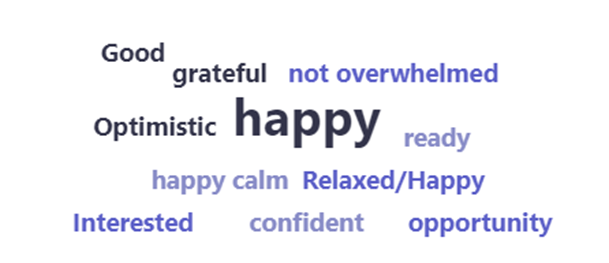
Designed and developed a series of training sessions to build the capability of trainers across the Loddon Mallee Health Network. Provided tips and tricks to assist with using the new HR platform AND used ADDIE to create cadence, inclusion and regular evaluation. I asked the cohort how they were feeling about the training?
In YOUR face, the future of digital marketing
What is your company brand? What is your personal brand? How important are data analytics? These questions and many more were answered by digital specialists in an online event I curated and facilitated.
Want more….
If you want to understand more about my capabilities, in particular how I have applied the valuable things learned throughout my Masters, please read my Capability Statement below.
Capability Statement
One of my key strengths is developing strategies for the implementation of technology changes in projects relating to learning and development. I have been a lead in managing change relating to the development of digital resources for flipped learning at a TAFE; I’ve designed and facilitated a number of initiatives to guide people from corporate environments to work in a startup, and more recently I have developed a train-the-trainer strategy to support the technical capability of a 5000 + workforce across 14 hospitals.
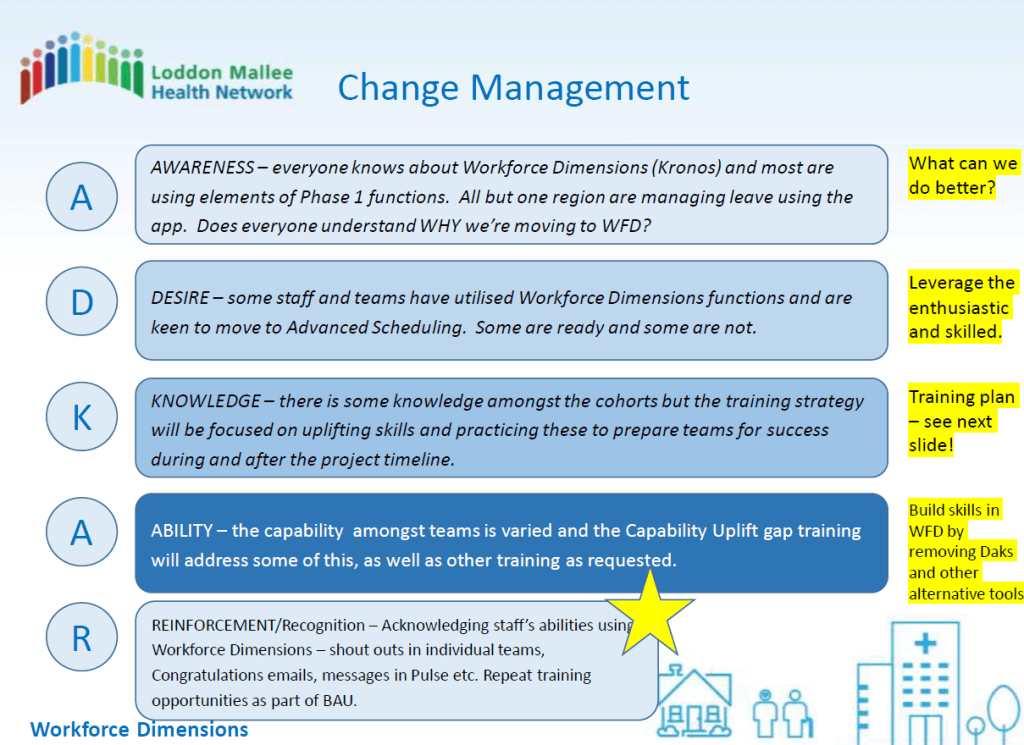
To achieve these outcomes I have adopted learnings from MEDLL to provide frameworks (I have used ADKAR to help punctuate the change elements of the digital transformation with health professionals),
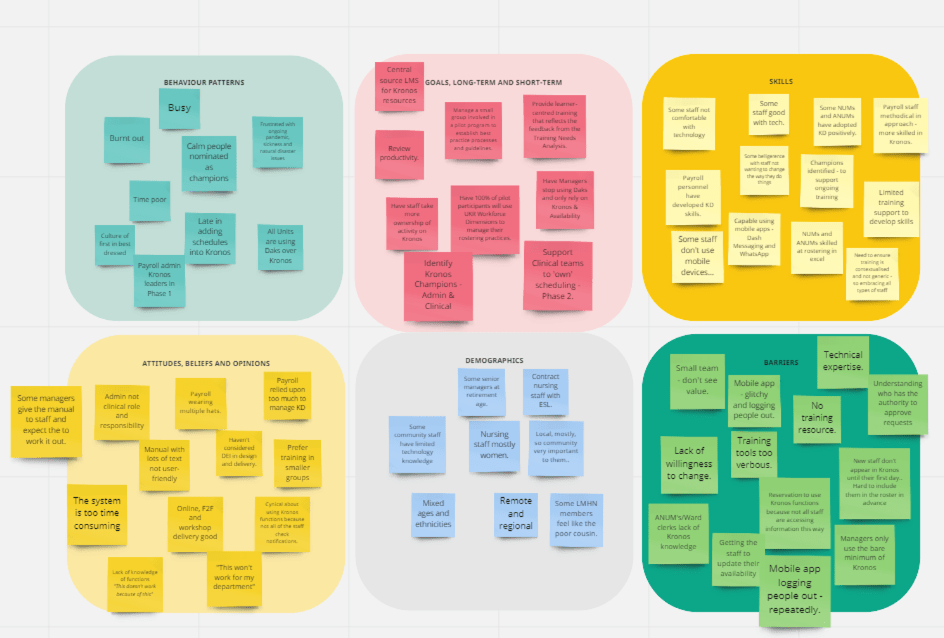
design thinking strategies (I have run a number of workshops with my team to help develop defined learner personas),
and identifying required research to implement small and large innovations (empathy interviews and informal discussions after training sessions helped achieve support to pursue a community of practice with key stakeholders, and look at a ‘business as usual’ strategy to sustain the project learnings, beyond the project timeline).
I am mindful of always adopting an inclusive strategy to ensure 1). The right people are invited to the decision-making table (I invited Directors and Executives to a strategic planning meeting with practitioners and the vendor, to ensure transparency and decision-making could be done efficiently and effectively). 2). Indigenous and Torres Strait Islander peoples are recognised and contribute to project/program outcomes where applicable (I reached out to a local Dja Dja Wurrung elder to support a research initiative to have Djaara people providing a recording of Welcome to Country on the website. I also met with an Aboriginal colleague to discuss the benefits of yarning circles and the correlation with agile retrospectives). 3). Link learning or project strategy to over-arching commercial goals and imperatives. 4). Establishing WIIFM to assist teams with change and understanding why the change is necessary, (sample of poster below) and 5). Ensure evaluation is part of entire process, including empathy interviews with all stakeholders and regular check-ins (via polls and surveys – some sample feedback below) to enable a pivot to a required change.

Digital enhancements, whether new applications, software, social media platforms, are always embedded in my strategies and supporting staff to develop their capabilities with technology has been a key focus over the past 3 years. I am mindful of the ethical issues regarding data and provide transparent and informed guidelines with regard to how data is used and who it is shared with.
I think having a marketing background has helped bring some light and shade to the projects I have worked on – been able to communicate effectively using social media, visual cues such as posters with QR codes and uploading sessions and videos to YouTube (refer to links above) are part of my practices.
Underpinning the work integrated learning with theoretical concepts has helped build a confident and decisive voice when communicating with Executive teams, to encourage new initiatives such as Communities of Practice and Design Thinking approaches.
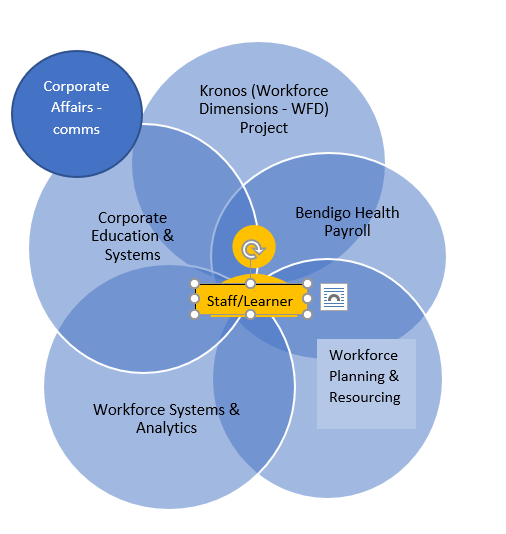
The ability to define an issue and what new knowledge is required to help solve or make progress on the issue has also allowed me to suggest research opportunities before moving forward with a new learning initiative (gathering data from the Community of Practice and feedback from the Train-the-Trainer cohort will provide the basis for a research initiative to review post-project effectiveness and governance). I have been particularly inspired by researchers where change is not driven by a top-down or one-sided approach but by peer to peer sharing with robust workplace engagement and acknowledgement – the timings, sayings, doings and things that are within a practice. Whilst results and KPIs are important considerations with any new learning strategy I think there is merit in the formal and informal opportunities to learn and share knowledge. This has been witnessed in the training sessions for the practitioners around the region – who have formed the Community of Practice and are sharing solutions, tips and tricks and posing questions via a dedicated Teams channel.
Learning can be about insight, sharing, communications and empathy, and applying reflective practices, for myself, and my colleagues has been an important new practice I will continue to encourage in new environments.
The discipline required to complete the Master of Education Learning and Leadership has also helped with my time-management, planning and transparency (using project management tools also helps with this) regarding the progression of my project work and the effectiveness of instigated strategies.
As a business owner (with my husband), a full-time employee, a Mother of 2 very bouncy young adults, I am proud of what I have learnt and how I have applied my learning, and really appreciated the wonderful sharing and learning provided by the staff at UTS.
 Site Title